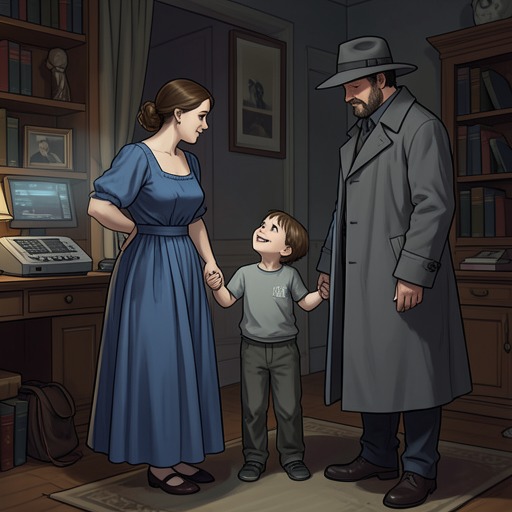
“Rick and Josie forever” painting
Klara and the SunThe “Rick and Josie forever” painting is a gift Josie makes for Rick while her illness is a serious concern and their relationship is strained. Its dark, densely tangled imagery sets a peaceful pair walking hand in hand apart from the surrounding hostility, giving visual form to a wish for lasting closeness. The drawing travels from Josie’s bedside to Rick’s home, but its arrival cannot by itself settle the conflict between them; Rick’s later decision to frame it offers a quieter sign that he has received and kept the gesture.
Making and Sending the Picture
Josie works on the drawing in her bedroom while Klara sits on the Button Couch, turned towards her and ready to converse. After tearing up an earlier page and hiding it in the crevice between her duvet and the wall, Josie starts afresh, drawing for almost an hour before putting down her sharp pencil. She asks Klara for a large padded envelope from the lower-left drawer. As Klara retrieves it, Josie writes on the picture, folds it with a blank sheet between the halves to prevent smudging, and carefully seals it inside.
The care given to the envelope makes the picture more than a drawing left in a room. Josie turns the sealed parcel in her hands, saying she is glad the work is done, then asks Klara to put it back in the same lower-left drawer. Klara does not immediately do so: holding the envelope in the middle of the room, she recognizes that it may be a special gift from Josie to Rick. Josie’s request has given a private creation a specific destination, though she does not show its contents to Klara before sending it.
Image and Inscription
When Klara brings the envelope to Rick, he has just been speaking with her about Josie’s condition, which he believes may be very serious. He rises from the sofa to receive the picture and opens the envelope carefully. Looking at the drawing, he reads its title aloud: “Rick and Josie forever.” The inscription makes explicit what the image conveys more obliquely: a claim on a shared future and a declaration of attachment.
The composition sharply divides the page. Much of it is filled with pointed, angry-looking objects tangled into an impenetrable mesh. Josie uses pencils of many colors, but the overall effect is dark and forbidding. In the lower-left corner, by contrast, she preserves a clear and tranquil space. Two small, stick-like figures—a boy and a girl—walk away hand in hand, their backs turned to passers-by; they appear happy and without worries.
A bubble above the pair contains the title, but it has neither the usual tail nor the dots that would mark it as one person’s thought. Its form therefore resembles a poster slogan or an advertisement on a taxi door more than private speech. That difference matters: the words are not assigned to either figure as an individual thought, but stand over them as a shared declaration. The calm corner does not erase the darkness around it; the picture holds the hoped-for intimacy inside a world represented as tangled and threatening.
Gift and Unresolved Hurt
Klara tells Rick that Josie worked especially hard on the picture. He studies it for a long time, his face close to a smile, and calls it a kind picture. Yet the gift arrives against a history of conflict that Rick does not regard as easily repaired. He explains that Josie has been getting at him, that she pushes matters too far, and that she seems to expect a nice picture to fix what has happened. Sending Klara with the drawing, he says, does not make the problem disappear; he wants Josie to understand that things are not so easily put right.
Klara suggests that Josie hoped Rick would come in person to thank her. Rick’s smile fades at the suggestion. He points to Klara’s presence as a reminder that she has seen how Josie treats him, and insists that a person need not accept everything. His response gives the picture a double significance: it is a sincere attempt at connection, but also a test of whether affection can repair an injury that remains unspoken in the image itself. Rick accepts the work and recognizes its kindness without pretending that the act settles their disagreement.
Framing and Afterlife
The drawing’s meaning continues after its delivery. On a later meeting, Rick tells Josie that he liked it and put it in a frame the previous night. He has used one of her mother’s old frames, taking out a picture of a zebra and replacing it with Josie’s work. The specific act of making room for the drawing gives his earlier response a material continuation: he has not simply thanked Josie through Klara and set the picture aside, but chosen to display it.
That later exchange does not establish that every grievance has vanished. Instead, the framed picture records a bond that persists alongside conflict. Its promise of “forever” is therefore neither a simple guarantee nor an uncomplicated happy ending. The image preserves the possibility the children wish for—a boy and girl walking together, apart from the crowd—while the circumstances of its delivery and Rick’s hesitation show how much remains between that wish and its fulfilment.